
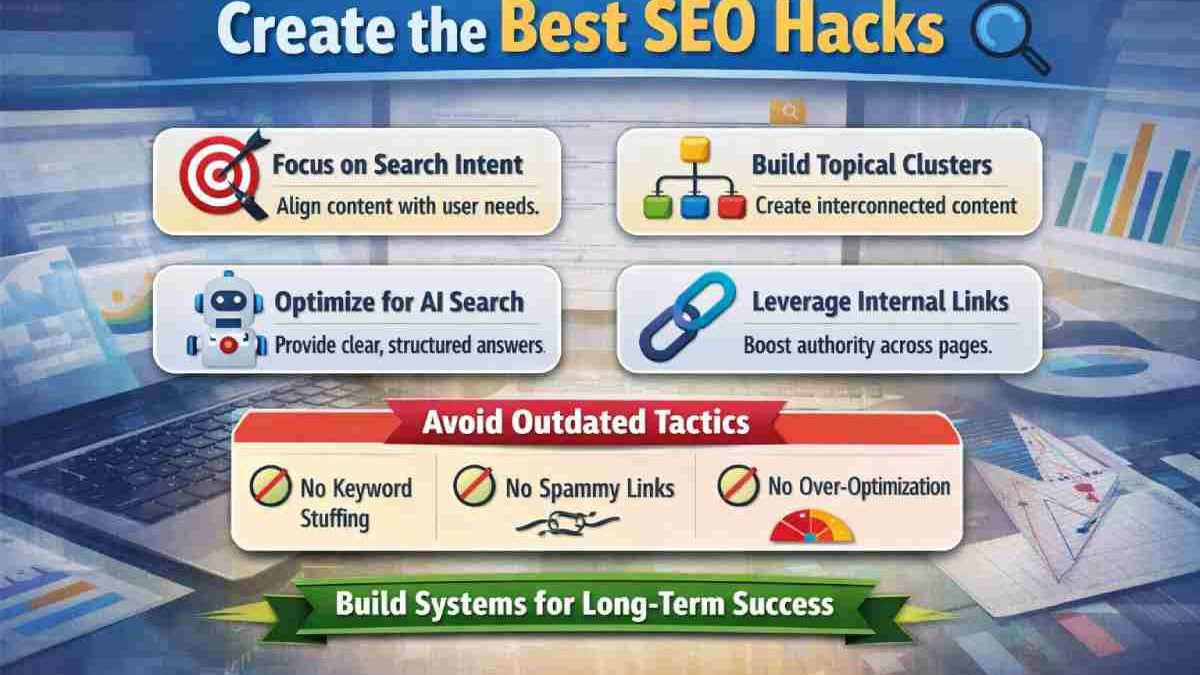

Most SEO hacks are outdated and ineffective; real results now come from leverage-based systems that align with search intent, authority, and AI-driven ranking signals.
Most people searching for “SEO hacks” want quick wins. The reality is simple: there are no reliable shortcuts anymore. Google has shifted from rewarding tricks to rewarding clarity, intent match, and topical authority. If your strategy is still built on isolated tactics, you’ll see inconsistent or stagnant results.
The direct answer:
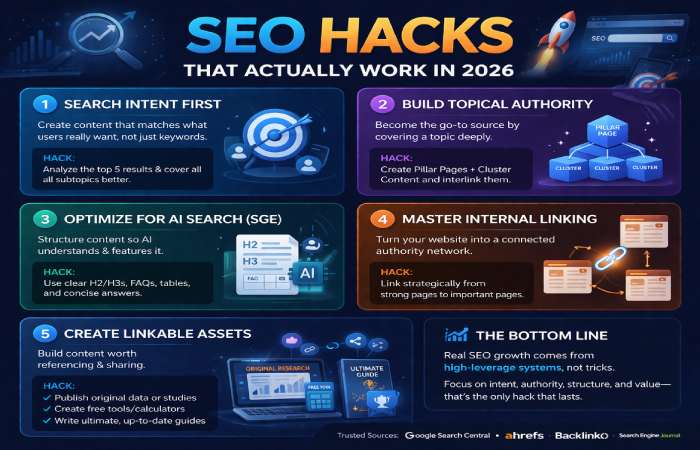
The only SEO hacks that work in 2026 are high-leverage systems like search intent optimization, topical authority clusters, structured content for AI search, and strategic internal linking.
Instead of chasing dozens of low-impact tactics, you need to focus on a few actions that create compounding results over time. This article breaks down exactly what those are—and how to implement them.
This Article Belongs to SEO
Table of Contents
Why Most SEO Hacks Fail
The idea of “SEO hacks” comes from an outdated version of search engines—when small tweaks could significantly impact rankings. Today, marketers also need to understand the differences between manual vs automatic SEO approaches and how they affect implementation.
The Core Problem
Most SEO advice is:
- Fragmented
- Outdated
- Lacking prioritization
Beginners often implement everything they read, expecting results. But without a system, these efforts don’t compound.
What Google Actually Rewards
According to Google Search Central, modern ranking systems prioritize:
- Helpful, people-first content
- Clear intent satisfaction
- Expertise and trust signals
Why Hacks Break Over Time
| Reason | Explanation | Impact on Rankings |
|---|---|---|
| Algorithm updates | Google constantly evolves | Old tricks stop working |
| Signal complexity | Hundreds of ranking factors | No single tactic dominates |
| AI integration | Better understanding of content | Manipulation becomes harder |
| User behavior tracking | Engagement signals matter | Low-value content drops |
Bottom line: Hacks fail because they try to exploit a system that’s designed to evolve.
The Leverage Framework: What Actually Works
A better way to think about SEO is through leverage:
SEO Actions by Leverage Level
| Level | Type | Examples | Impact | Use Case |
|---|---|---|---|---|
| Low | Cosmetic tweaks | Meta tags, keyword density | Minimal | Final optimization |
| Medium | Structural improvements | Internal linking, formatting | Moderate | Supporting role |
| High | Strategic systems | Intent, authority, clusters | Massive | Core strategy |
Low-Leverage SEO Hacks
These are the most commonly discussed—but least impactful.
Examples
- Changing keyword density from 1% to 2%
- Rewriting meta descriptions repeatedly
- Adding keywords to headings unnaturally
Reality Check Table
| Tactic | Common Claim | Reality | Recommendation |
|---|---|---|---|
| Keyword density | Improves rankings | No strong evidence | Ignore |
| Meta description | Boosts SEO | Only affects CTR | Use once, move on |
| Exact keyword usage | Required for ranking | Google understands context | Write naturally |
These tactics are not harmful—but they are not growth drivers.
Medium-Leverage SEO Necessary but Not Sufficient
These actions help—but only when combined with stronger strategies.
On-page SEO improves clarity and helps search engines understand the purpose and structure of a page. For WordPress websites, on-page SEO in WordPress can provide a practical framework for implementing these improvements.
Key Medium-Leverage Factors
| Factor | Why It Matters | Limitation |
|---|---|---|
| On-page SEO | Improves clarity | Doesn’t create authority |
| Internal linking | Distributes ranking power | Needs content depth |
| Content formatting | Improves readability | Doesn’t drive traffic alone |
High-Leverage SEO Systems Where Growth Happens
This is where modern SEO lives.
High-Leverage Systems Overview
| System | What It Does | Why It Works |
|---|---|---|
| Search intent matching | Aligns with user needs | Google prioritizes relevance |
| Topical authority | Builds subject expertise | Signals trust and depth |
| Content structure | Improves comprehension | Helps AI and users |
| Linkable assets | Attracts backlinks | Builds authority |
These systems are supported by research and case studies from platforms like Ahrefs and Backlinko, which consistently show that comprehensive, well-structured content outperforms isolated optimizations.
SEO Hacks vs SEO Systems
| Criteria | SEO Hacks | SEO Systems |
|---|---|---|
| Focus | Quick wins | Long-term growth |
| Structure | Disconnected | Integrated |
| Results | Inconsistent | Compounding |
| Risk | High (penalties) | Low (aligned with Google) |
Modern SEO Hack #1 – Search Intent Domination
Search intent is the single most important ranking factor today. Understanding the difference between SEO vs SEM can also help clarify where organic search fits within a broader digital marketing strategy.
Types of Search Intent
| Type | Example | Content Format |
|---|---|---|
| Informational | “SEO hacks” | Guides, lists |
| Commercial | “best SEO tools” | Comparisons |
| Transactional | “buy SEO software” | Landing pages |
Intent Optimization Checklist
| Step | Action | Outcome |
|---|---|---|
| Analyze SERP | Study the top results and use SERP data | Understand expectations |
| Match format | Use same structure | Improves relevance |
| Match depth | Align content length/detail | Avoid under/overwriting |
| Answer early | Provide quick answers | Improves AI visibility |
Modern SEO Hack #2 – Topical Authority Clusters
Instead of targeting isolated keywords, build topic ecosystems.
Cluster Model Breakdown
| Component | Role | Example |
|---|---|---|
| Pillar page | Main topic | SEO Hacks |
| Cluster content | Supporting topics | Keyword research |
| Internal links | Connect everything | Context signals |
Example Scenario (Illustrative)
| Blog Type | Strategy | Result (6 Months) |
|---|---|---|
| Random blog | Single posts | Flat traffic |
| Cluster blog | Interlinked content | Compounding growth |
This approach aligns with insights from Search Engine Journal, which emphasizes topical depth over keyword targeting.
Modern SEO Hack #3 – Content That AI Can’t Ignore
Clear, useful writing remains important as search experiences become more AI-driven. Strong SEO copywriting combines search intent, readability, topical coverage, and natural keyword usage.
AI Optimization Table
| Element | Best Practice | Reason |
|---|---|---|
| Structure | Use headings | Improves parsing |
| Clarity | Short answers | AI extracts easily |
| Coverage | Include related topics | Enhances context |
| Formatting | Lists & tables | Improves readability |
Modern SEO Hack #4 – Internal Linking as a Ranking Engine
Internal linking is often underestimated—but extremely powerful.
Internal Linking Strategy
| Strategy | Description | Benefit |
|---|---|---|
| Hub model | Central pillar page | Authority consolidation |
| Contextual links | Within content | Relevance signals |
| Authority flow | Link from strong pages | Faster indexing |
Outdated SEO Hacks You Should Ignore
Many tactics still circulate—but they no longer work.
Outdated vs Modern SEO
| Outdated Tactic | Modern Alternative |
|---|---|
| Keyword stuffing | Intent-focused writing |
| Link spam | Authority building |
| Thin content | Comprehensive guides |
| Over-optimization | Natural structure |
Google’s spam policies explicitly discourage manipulative tactics, reinforcing the shift toward quality over tricks.
Execution Plan – From Hacks to Systems
Here’s how to implement everything practically:
Step-by-Step SEO System
| Step | Action | Outcome |
|---|---|---|
| 1 | Choose topic cluster | Focused strategy |
| 2 | Create pillar content | Authority base |
| 3 | Build supporting pages | Depth |
| 4 | Add internal links | Connectivity |
| 5 | Optimize for intent | Rankings |
Common Mistakes Even Professionals Make
Even experienced SEO practitioners struggle—not because they lack knowledge, but because they focus on the wrong things.
Ignoring technical problems can also cause serious visibility losses. When important pages disappear from Google’s index, understanding how to recover a site deindexed by Google can be an important part of an SEO recovery process.
Mistake Breakdown
| Mistake | Why It Happens | Fix |
|---|---|---|
| Chasing volume | Misleading keyword tools | Focus on intent |
| Ignoring updates | Content fatigue | Refresh regularly |
| Weak structure | Lack of planning | Use frameworks |
Conclusion
SEO has fundamentally changed. It is no longer about tricks, shortcuts, or isolated tactics that promise quick wins but deliver inconsistent results. Instead, modern SEO is built on systems, alignment with search intent, and strategies that compound over time. The biggest shift is this: the real SEO hack in 2026 is understanding that traditional “hacks” don’t work anymore—and focusing instead on building high-leverage systems that consistently drive sustainable growth.
