
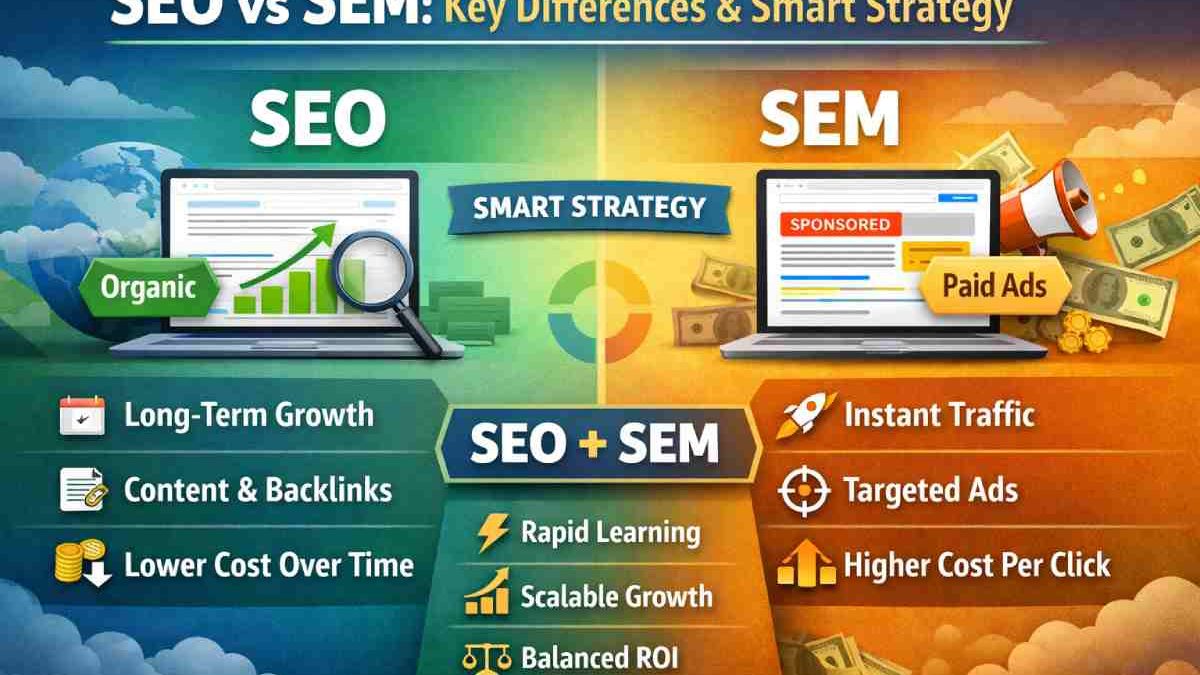
SEO builds long-term leverage while SEM delivers immediate momentum; the highest-performing strategy integrates both into a compounding growth system.
Most people searching “SEO vs SEM” want a simple answer: which one should you use?
This Article Belongs to SEO
Here it is—direct and clear:
Table of Contents
SEO vs SEM Explained Quick Clarity
What Is SEO?
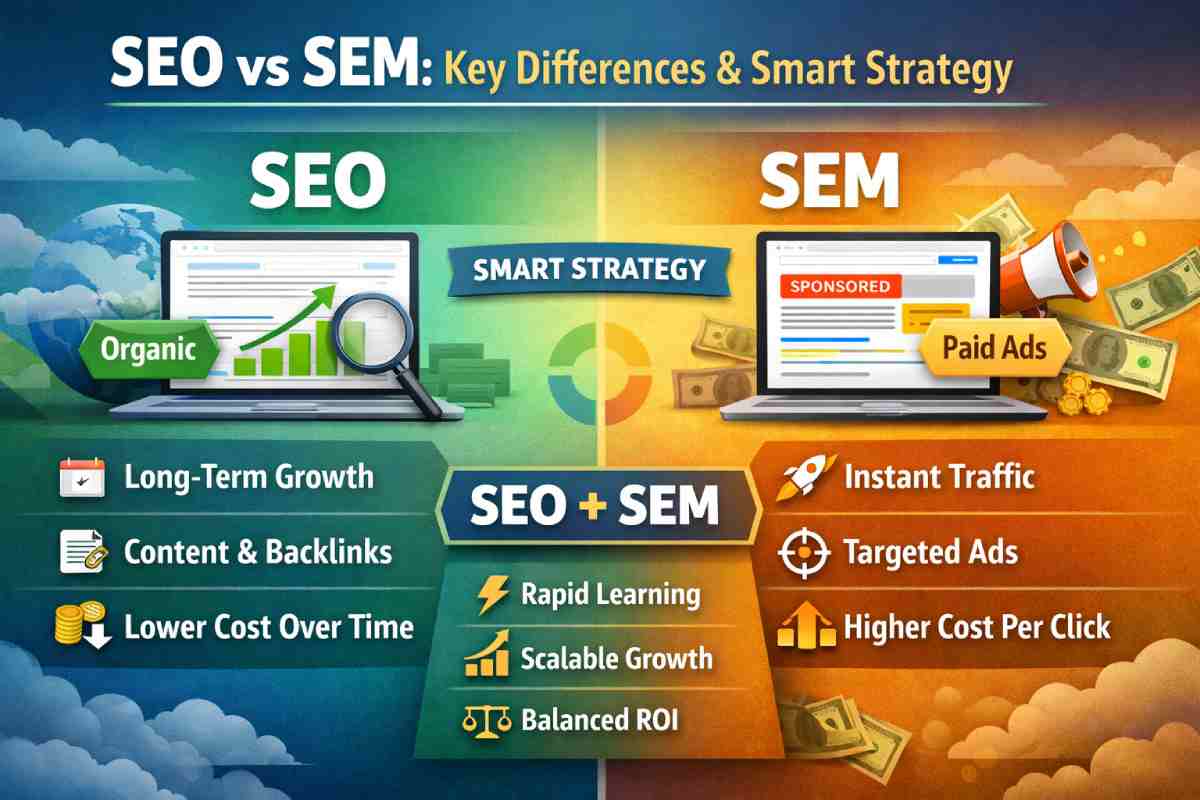
Search Engine Optimization (SEO) is the process of improving your website to rank organically in search engines. This includes content creation, keyword optimization, backlink building, and user experience improvements.
SEO is a long-term asset. Once content ranks, it can generate traffic consistently without paying for each visitor. Businesses can strengthen this process by applying practical SEO hacks that focus on search intent, content quality, internal linking, and topical authority.
Google’s official SEO Starter Guide explains how website owners can make their content easier for search engines to discover, understand, and present in search results.
What Is SEM?
Search Engine Marketing (SEM) refers to paid search advertising, typically through platforms like Google Ads.
With SEM:
- You bid on keywords
- Pay per click (PPC)
- Get immediate visibility
SEM is a traffic-on-demand system, ideal for quick results and testing.
SEO vs SEM: Core Differences Table
| Factor | SEO | SEM |
|---|---|---|
| Traffic source | Organic | Paid |
| Speed | Slow (months) | Instant |
| Cost model | Content investment | Pay per click |
| Sustainability | High | Low |
| Control | Algorithm-based | Budget-based |
| ROI pattern | Compounding | Linear |
The Real Difference: Time, Cost, and Control
The biggest difference is not “free vs paid”—it’s how each behaves over time.
Time Perspective
- SEO takes time to build but grows steadily
- SEM delivers results instantly but stops when spending stops
Cost Behavior
- SEO: upfront effort, lower cost per visitor over time
- SEM: ongoing cost for every click
Control Factor
- SEO: depends on search engine algorithms
- SEM: fully controllable via budget and targeting
SEO as a Compounding Asset
SEO works like an investment. The more high-quality content and authority you build, the more your traffic grows without proportional cost increases.
The quality of the content also matters. Effective SEO copywriting combines search intent, useful information, natural keyword usage, and readability to create content that serves both users and search engines.
SEO takes time to build and requires consistent optimisation, content development, and technical work. The approach can also vary depending on whether a business uses manual vs automatic SEO processes to manage its campaigns.
How SEO Compounds Over Time
| Timeline | SEO Activity | Result |
|---|---|---|
| Month 1 | Publish content | Minimal traffic |
| Month 3 | Content indexed and ranking | Early traffic |
| Month 6 | Backlinks + authority | Steady growth |
| Month 12+ | Strong rankings | High traffic with low cost |
Example Scenario (Illustrative)
A blog post targeting “best CRM software”:
- Month 1: 0 visits
- Month 6: 500 visits/month
- Month 12: 5,000+ visits/month
No additional cost per click.
External Insight
Studies by Ahrefs show that most web pages get little traffic—not because SEO doesn’t work, but because content lacks depth, authority, or proper targeting.
Similarly, Moz emphasizes that backlinks and content quality remain key ranking factors.
SEM as a Speed & Data Engine
SEM is designed for immediate results and rapid testing.
How SEM Works in Practice
| Step | Action | Outcome |
|---|---|---|
| Week 1 | Launch ad campaigns | Traffic starts immediately |
| Week 2 | Analyze keyword performance | Identify winners |
| Week 3 | Optimize ads and landing pages | Increase conversions |
| Week 4 | Scale budget | Predictable growth |
Example Scenario (Illustrative)
You run ads for 10 keywords:
- 3 convert well → focus budget
- 7 fail → eliminate
Within weeks, you gain insights that SEO alone would take months to provide.
External Insight
According to Google Marketing Platform, businesses that use data-driven marketing strategies improve ROI significantly through continuous optimization.
SEO vs SEM Cost Comparison
| Cost Element | SEO | SEM |
|---|---|---|
| Initial investment | High (content, tools) | Medium (ads setup) |
| Ongoing cost | Moderate | High |
| Cost per click | Indirect (free traffic) | Paid |
| Long-term ROI | High | Moderate |
| Scalability cost | Low | High |
Cost Scenario (Illustrative)
| Channel | Investment | Traffic | Cost per Visitor |
|---|---|---|---|
| SEM | ₹100,000 | 1,000 clicks | ₹100 |
| SEO | ₹100,000 | 10,000 visits (over time) | ₹10 |
Over time, SEO becomes significantly more cost-efficient.
The Integration Model: SEO + SEM Strategy
The most effective approach is combining both.
Growth Phases Table
| Phase | Strategy | Goal |
|---|---|---|
| Phase 1 | SEM | Validate keywords and offers |
| Phase 2 | SEO | Build content around proven topics |
| Phase 3 | Hybrid | Reduce ad spend, scale organic |
How the System Works
- SEM identifies high-performing keywords
- SEO builds long-term traffic around those keywords
- Organic growth reduces paid dependency
This creates a loop:
SEM → Data → SEO → Organic Growth → Lower Costs
When to Use SEO vs SEM
Decision Framework Table
| Situation | Best Choice |
|---|---|
| Need immediate traffic | SEM |
| Limited budget | SEO |
| Launching product | SEM first |
| Scaling business | Combine both |
| Competitive niche | Hybrid approach |
Common Mistakes And How to Avoid Them
SEO Mistakes Table
| Mistake | Impact | Fix |
|---|---|---|
| Generic content | No rankings | Create in-depth content |
| No backlinks | Low authority | Build link strategy |
| Ignoring intent | High bounce rate | Match search intent |
| Impatience | Early failure | Commit long-term |
SEM Mistakes Table
| Mistake | Impact | Fix |
|---|---|---|
| No tracking | Wasted budget | Use analytics tools |
| Broad keywords | High CPC | Target specific keywords |
| Poor landing pages | Low conversions | Optimize UX |
| No testing | Stagnation | Run A/B tests |
The Future: AI Search Impact
Search engines are evolving with AI.
Key Changes
| Area | Impact |
|---|---|
| SEO | Focus on authority and depth |
| SEM | Higher competition and CPC |
| Content | Must be unique and valuable |
| Strategy | Integration becomes essential |
Organizations like Google are prioritizing helpful, experience-driven content, making low-quality SEO ineffective.