


Sustainable mobile app growth comes from optimizing the entire user lifecycle—not just driving installs. Marketing, product experience, and monetization must function as one compounding system.
Most people searching for a mobile app marketing guide want more downloads. The real answer is broader: you need the right users, fast value delivery, strong retention, and revenue alignment. Without those, installs are just expensive vanity metrics.
The mobile market is saturated. Advertising costs are rising globally, privacy restrictions limit tracking, and users abandon most apps within days. Many companies react by increasing ad spend, which accelerates losses if activation and retention are weak.
The solution is lifecycle marketing — a system connecting discovery, onboarding, engagement, retention, monetization, and advocacy. When these stages reinforce each other, growth compounds. When they don’t, even viral launches collapse.
Table of Contents
The Modern App Growth Lifecycle
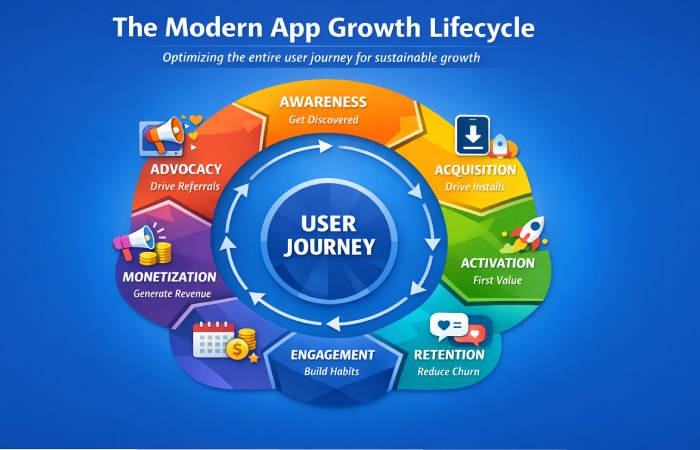
Growth is circular, not linear. Users move through repeating stages.
| Stage | Goal | Key Success Indicator |
|---|---|---|
| Awareness | Get discovered | Target users recognize your app |
| Acquisition | Drive installs | Efficient CPI with quality users |
| Activation | Deliver first value | Successful first session |
| Engagement | Build habits | Frequent usage |
| Retention | Reduce churn | Users return long-term |
| Monetization | Generate revenue | Sustainable LTV |
| Advocacy | Encourage sharing | Organic growth |
Tech giants like Google optimize campaigns for downstream actions (subscriptions, purchases) rather than installs — highlighting the shift toward value-based growth.
App Store Optimization ASO: Your Highest-Intent Channel
Key ASO Elements
| Element | Why It Matters | Optimization Tip |
|---|---|---|
| App Title | Ranking | Include main keyword |
| Icon | First impression | Bold, recognizable |
| Screenshots | Conversion | Show outcomes |
| Video | Demonstration | Reduce uncertainty |
| Reviews | Trust | Encourage happy users |
Localization can dramatically increase installs in non-English markets.
Paid User Acquisition: Scale Carefully
Channel Comparison
| Channel | Strength | Weakness | Best For |
|---|---|---|---|
| Search Ads | High intent | Limited scale | Utilities, tools |
| Social Ads | Massive reach | Lower intent | Lifestyle apps |
| Video Ads | Strong storytelling | Costly | Games, entertainment |
| Display | Cheap awareness | Low conversion | Branding |
LTV-First Thinking
Never optimize only for cheap installs.
| Scenario | CPI | LTV | Outcome |
|---|---|---|---|
| Low-quality users | Low | Very low | Loss |
| High-quality users | Higher | Much higher | Profit |
Activation & Onboarding: Where Most Growth Is Won
Consultancies like Bain & Company emphasize that early experience strongly predicts long-term retention.
High-Impact Onboarding Principles
| Principle | Benefit | Example |
|---|---|---|
| Immediate value | Builds trust | Show results instantly |
| Progressive steps | Reduces overwhelm | Feature rollout |
| Guided actions | Prevents confusion | Checklist onboarding |
| Personalization | Increases relevance | Ask goals |
Apps that demand too much upfront information often lose users immediately.
Engagement: Building Habit Loops
| Channel | Strength | Risk |
|---|---|---|
| Push | Instant reach | Fatigue if overused |
| Rich content | Lower visibility | |
| In-App | Contextual | Limited reach |
| SMS | High attention | Intrusive |
Behavior-triggered messaging is far more effective than generic blasts. Platforms like Duolingo succeed by tying notifications to streaks and progress.
Retention: The True Growth Multiplier
Retention reduces dependence on expensive acquisition.
| Strategy | Mechanism | Result |
|---|---|---|
| Personalization | Relevant experience | Higher usage |
| Gamification | Rewards & streaks | Habit formation |
| Community | Social bonds | Loyalty |
| Updates | Fresh value | Reduced churn |
| Support | Problem resolution | Trust |
Small retention gains can dramatically increase revenue.
Monetization Models Shape Marketing
| Model | User Expectation | Marketing Focus |
|---|---|---|
| Subscription | Ongoing value | Reliability |
| Freemium | Upgrade incentives | Feature comparison |
| In-App Purchases | Enhancements | Engagement depth |
| Ads | Free access | Scale |
| One-Time | Ownership | Quality & trust |
Mismatch between messaging and pricing causes churn.
Product-Led Growth & Viral Loops
| Loop Type | Growth Mechanism |
|---|---|
| Referral | Invite rewards |
| Content Sharing | User-generated exposure |
| Marketplace | More users = more value |
| Data | Usage improves results |
Companies like Uber scaled partly because each new participant improved the service for others.
Analytics in the Privacy Era
Tracking is shifting toward first-party data due to platform restrictions and regulations.
Essential Metrics Dashboard
| Metric | Why It Matters |
|---|---|
| Acquisition Cost | Efficiency |
| Activation Rate | Early success |
| Retention | Sustainability |
| Engagement | Habit strength |
| Revenue per User | Profitability |
Research firms such as Gartner highlight predictive analytics as key to competitive advantage.
Global vs Local Marketing
| Element | Localization Example |
|---|---|
| Language | Native translation |
| Pricing | Adjust to local income |
| Payments | Regional methods |
| Culture | Relevant imagery |
| Store Assets | Local screenshots |
Privacy laws vary by region (GDPR in EU, others elsewhere), affecting data strategies.
Common Mobile App Marketing Mistakes
| Mistake | Consequence |
|---|---|
| Install obsession | Unsustainable growth |
| Weak onboarding | High early churn |
| Notification spam | User opt-outs |
| Poor differentiation | Low conversion |
| Ignoring cohorts | Misleading averages |
Step-by-Step Marketing Roadmap
Foundations
| Task | Purpose |
|---|---|
| Validate problem | Ensure demand |
| Define audience | Target effectively |
| Optimize onboarding | Improve activation |
| Set analytics | Measure progress |
Efficient Growth
| Task | Purpose |
|---|---|
| Improve ASO | Organic installs |
| Test paid ads | Scalable acquisition |
| Retention programs | Increase LTV |
| Lifecycle messaging | Personalized engagement |
Scalable Expansion
| Task | Purpose |
|---|---|
| Growth loops | Self-sustaining users |
| Market expansion | New audiences |
| Pricing optimization | Revenue growth |
| Brand building | Long-term trust |
Global Mobile App Marketing Agencies
| Agency | Country | Typical Pricing | Best For |
|---|---|---|---|
| App marketing agencies (US) | USA | $5k–$50k/month | Large budgets |
| European growth firms | UK/EU | €4k–€40k/month | GDPR-compliant growth |
| Boutique studios | Global | $2k–$15k/month | Startups |
| Freelancers | Worldwide | $500–$5k/month | Small projects |
(Exact pricing varies widely based on scope and ad spend.)
Conclusion
Mobile app marketing is no longer about launching campaigns — it is about building systems. Apps that succeed convert attention into lasting value through activation, engagement, retention, and aligned monetization.
The real goal is not to be downloaded once, but to become part of users’ daily lives.
