
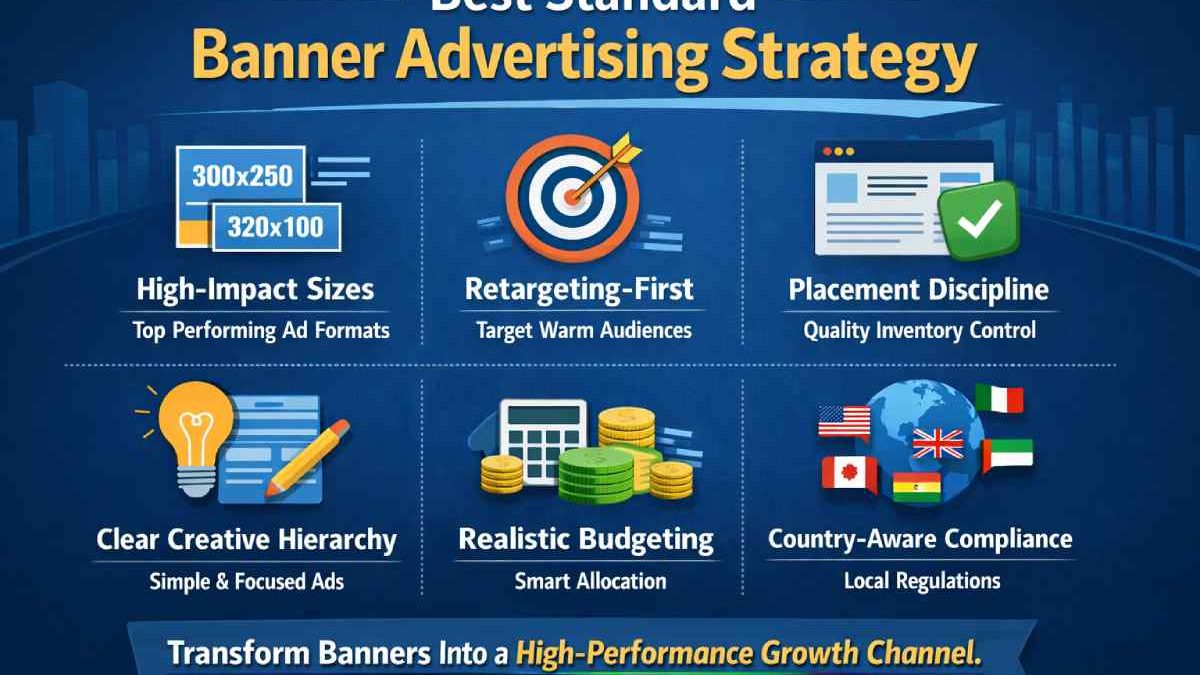
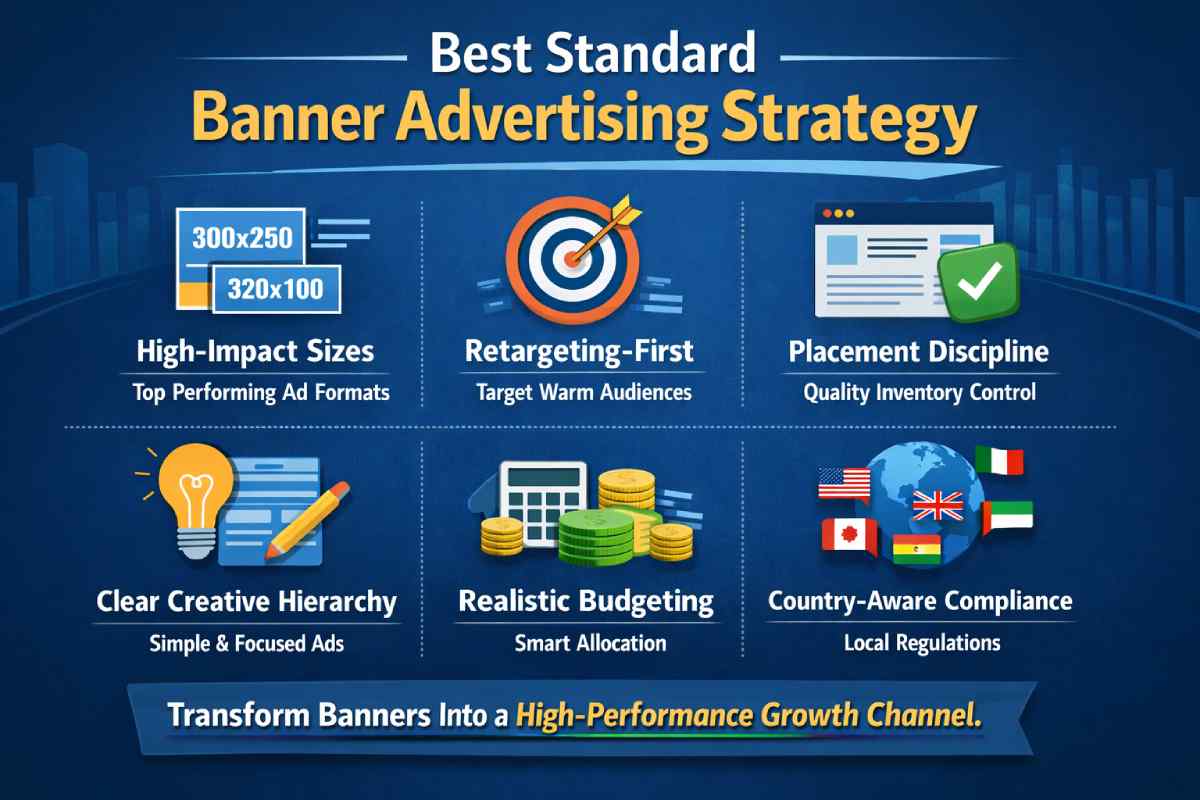
The best standard banner advertising strategy is not about using every IAB size—it’s about prioritizing high-impact formats, controlling placement quality, and structuring campaigns around retargeting and measurable conversions.
Most businesses assume banner ads underperform because “display doesn’t convert.” The reality is simpler and harsher: banner campaigns fail due to poor structure. Random sizes. Broad targeting. Cheap placements. No frequency caps. No conversion tracking. High impressions look impressive in dashboards, but revenue remains flat. The best standard banner advertising approach is to start with 300×250 and 320×100 formats, launch retargeting-first campaigns, control placement quality, and optimize for conversions—not CTR.
If you follow that structure, banner ads become a predictable mid-funnel growth lever. If you ignore it, they become digital wallpaper.
Table of Contents
What “Standard Banner Advertising” Means in 2026
Standard banner advertising refers to display ads built according to specifications defined by the Interactive Advertising Bureau. These sizes allow ads to run across publisher networks consistently.
You typically access banner inventory via:
-
Google Display Network
-
Meta Ads
-
Amazon Ads
-
Direct publisher partnerships
-
Programmatic exchanges
Standardization enables scale. Strategy enables profitability.
Most online guides list sizes. Few explain how those sizes perform differently across funnel stages. That gap is where ROI lives.
Banner Sizes Ranked by Conversion Impact
Tier 1 – Performance Workhorses
| Size | Best Funnel Stage | Why It Converts | Device Strength | Limitation |
|---|---|---|---|---|
| 300×250 | Mid-funnel | Native content placement | Desktop + Mobile | Can blend in |
| 320×100 | Mobile retargeting | Prominent mobile slot | Mobile | Limited desktop use |
These formats integrate into user flow without aggressive interruption. That subtlety improves engagement quality.
Tier 2 – Awareness Amplifiers
| Size | Strength | Weakness | Best Use Case |
|---|---|---|---|
| 728×90 | Top-of-page visibility | Desktop heavy | Brand awareness |
| 160×600 | Long exposure time | Narrow design constraints | B2B storytelling |
These formats are strong for reach and recall but weaker for direct response unless paired with retargeting.
Services Offered in Standard Banner Advertising
Banner advertising today is rarely just “placing ads.” It’s a layered service model involving creative, targeting, and analytics.
Core Service Categories
| Service Type | What It Includes | Who It’s For |
|---|---|---|
| Campaign Setup | Account configuration, pixel installation | Beginners |
| Creative Design | Banner design, copywriting, resizing | Brands without in-house designers |
| Audience Targeting | Retargeting setup, contextual layers | Performance marketers |
| Managed Placements | Premium site buying | Mid-size to enterprise |
| Optimization & Reporting | Weekly performance adjustments | Growth-stage companies |
| Programmatic Buying | DSP-based inventory acquisition | Advanced teams |
Agencies and freelancers often bundle these into monthly retainers or performance-based contracts.
Pricing Benchmarks (US Market Focus)
Pricing depends on inventory quality, targeting precision, and service layer.
Platform Advertising Costs
| Platform | Typical CPM Range | CPC Range | Best For |
|---|---|---|---|
| Google Display Network | Lower–Moderate | Low–Moderate | Scale + retargeting |
| Meta Ads | Moderate | Moderate | Audience layering |
| Amazon Ads | Moderate–Higher | Moderate | Product-focused brands |
| Direct Publisher | Higher | Varies | Brand safety |
Agency Service Pricing (Illustrative Ranges)
| Service Level | Monthly Fee (US) | What You Get |
|---|---|---|
| Freelancer | $500–$1,500 | Basic setup + reporting |
| Small Agency | $1,500–$5,000 | Creative + targeting + optimization |
| Performance Agency | $5,000+ | Full-funnel display management |
| Enterprise DSP Management | Custom pricing | Dedicated account team |
Important: Low ad spend with high management fees rarely makes sense. Align budget scale with service depth.
Country-Wise Availability & Market Differences
Standard banner advertising is global, but pricing and platform penetration vary.
Platform Availability by Country
| Country | GDN Availability | Meta Ads | Programmatic Maturity | Notes |
|---|---|---|---|---|
| United States | Full | Full | Very High | Most competitive market |
| United Kingdom | Full | Full | High | Strong compliance focus |
| Canada | Full | Full | High | Similar to US pricing |
| Australia | Full | Full | Moderate–High | Strong mobile usage |
| India | Full | Full | Growing | Lower CPM averages |
| Germany | Full | Full | High | GDPR strict enforcement |
| UAE | Full | Full | Growing | Premium publisher deals common |
Privacy regulation differs. EU markets operate under GDPR compliance requirements. US markets vary by state-level privacy rules. Audience retargeting scale may differ accordingly.
Budget Allocation Framework
The biggest mistake beginners make is allocating budget evenly across cold and warm audiences.
A more effective structure:
| Budget Allocation | Purpose |
|---|---|
| 60% | Retargeting |
| 30% | Contextual targeting |
| 10% | Creative testing |
This aligns spend with intent level.
Lower CPM cold traffic may generate awareness—but retargeting converts.
Creative Psychology Framework
Banner ads are interruptive. Simplicity converts.
Conversion Hierarchy
| Element | Role | Best Practice |
|---|---|---|
| Headline | Primary hook | 6–8 words |
| Visual | Attention anchor | Single focal image |
| CTA | Action driver | Clear benefit |
| Logo | Trust signal | Visible but subtle |
| White Space | Clarity enhancer | Avoid clutter |
Avoid:
-
Paragraph copy.
-
Multiple CTAs.
-
Over-designed visuals.
Placement & Inventory Strategy
Not all impressions are equal.
Inventory Quality Comparison
| Inventory Type | Risk Level | Conversion Potential | Best For |
|---|---|---|---|
| Open Exchange | Higher | Variable | Testing |
| Managed Placements | Moderate | Strong | Retargeting |
| Direct Deals | Lower | High | Brand-sensitive sectors |
Frequency cap recommendation: 3–5 impressions per user per day.
Without caps, banner fatigue reduces click and conversion probability.
Real-World Scenario Examples
SaaS Example
-
Demo visitors retargeted with 300×250.
-
7-day recency window.
-
Sequential messaging.
eCommerce Example
-
Cart abandoners shown product image banners.
-
5-day reminder sequence.
-
Limited-time discount CTA.
Education Example
-
Course page visitors retargeted.
-
Social proof-focused creative.
-
14-day nurturing window.
In each case, banner strategy supports search and social—not replaces them.
Beginner Launch Checklist
| Step | Action |
|---|---|
| 1 | Install conversion tracking |
| 2 | Design 300×250 + 320×100 |
| 3 | Launch retargeting audience |
| 4 | Set frequency caps |
| 5 | Test 2 creatives |
| 6 | Optimize weekly |
Avoid scaling before verifying conversion data.
Advanced Optimization Playbook
For intermediate and advanced marketers:
| Tactic | Purpose |
|---|---|
| View-through analysis | Measure assisted impact |
| First-party data layering | Improve targeting precision |
| Sequential creative rotation | Reduce fatigue |
| Managed placement negotiation | Improve inventory quality |
| Cross-channel attribution review | Understand banner contribution |
Industry organizations such as the Interactive Advertising Bureau and analytics firms like Nielsen frequently emphasize viewability, brand safety, and incremental lift over raw click volume.
Who This Strategy Is For
This guide is for:
-
Beginners launching their first display campaigns.
-
Mid-size brands optimizing ROI.
-
Marketers integrating display with search and social.
It is not for:
-
Businesses expecting cold banner ads to replace high-intent search traffic.
-
Brands unwilling to implement tracking and reporting discipline.
Final Verdict
High-impact banner sizes, retargeting-first campaigns, disciplined placement control, a clear creative hierarchy, realistic budgeting, and country-aware compliance are the pillars of effective standard banner advertising. Banner ads remain globally scalable across markets like the US, UK, Canada, Australia, India, Germany, and the UAE—but they reward discipline, not guesswork. When you treat banner advertising as a structured performance system—guided by data, creative clarity, and smart inventory selection—it becomes one of the most controllable and reliable mid-funnel growth channels in modern digital marketing.